
What should a website audit cover now that people ask AI instead of Google?
Before you read any of this, try something. Open ChatGPT and ask it to recommend a business like yours, in your area. See whether you come up.
Most of the businesses we run that test on don't. Not because their website is bad. Usually it looks great. It's that a machine can't read it.
A website audit used to be a design and performance exercise. Does it look current, does it load fast, does it rank. That list is still real, but it's no longer the whole job. A growing share of the people who'd hire you never see a results page at all. They ask ChatGPT, Perplexity, Gemini, or Copilot, get one answer, and act on it.
Which means an audit now has to ask a second question alongside the old one: not just how does this site look to a person, but what does a machine understand about this business, and does it match what the rest of the internet says?
Here's what that looks like in practice.
Can the AI tools actually read your site?
This is the plumbing, and it's where most sites quietly lose.
If your services, your locations, your hours, or your pricing live inside an image, a slider, a video, or a PDF, a person can read them and a machine mostly can't. Same for anything hidden behind a booking widget that loads separately from the page. If it isn't real text on the page, assume it doesn't exist as far as an AI answer is concerned.
The other piece is the behind-the-scenes code that tells Google and the AI toolswho you are, what you do, and where you are. It's invisible to visitors and it's the cheapest fix on any audit. Most small business sites don't have it, or have a broken version their theme added years ago.
Does your site answer questions, or just describe you?
AI tools quote answers. They almost never quote adjectives.
A page that opens with "we're a full-service studio committed to excellence" gives a language model nothing to work with. A page that opens with your actual range, your actual timeline, and what happens in week one gives it something to repeat.
The test is simple. Take the three questions you get asked most before someone hires you, cost, timeline, what happens first, and see how far down the page the answer sits. If it's paragraph four, it's effectively not there.
What does the rest of the internet say about you?
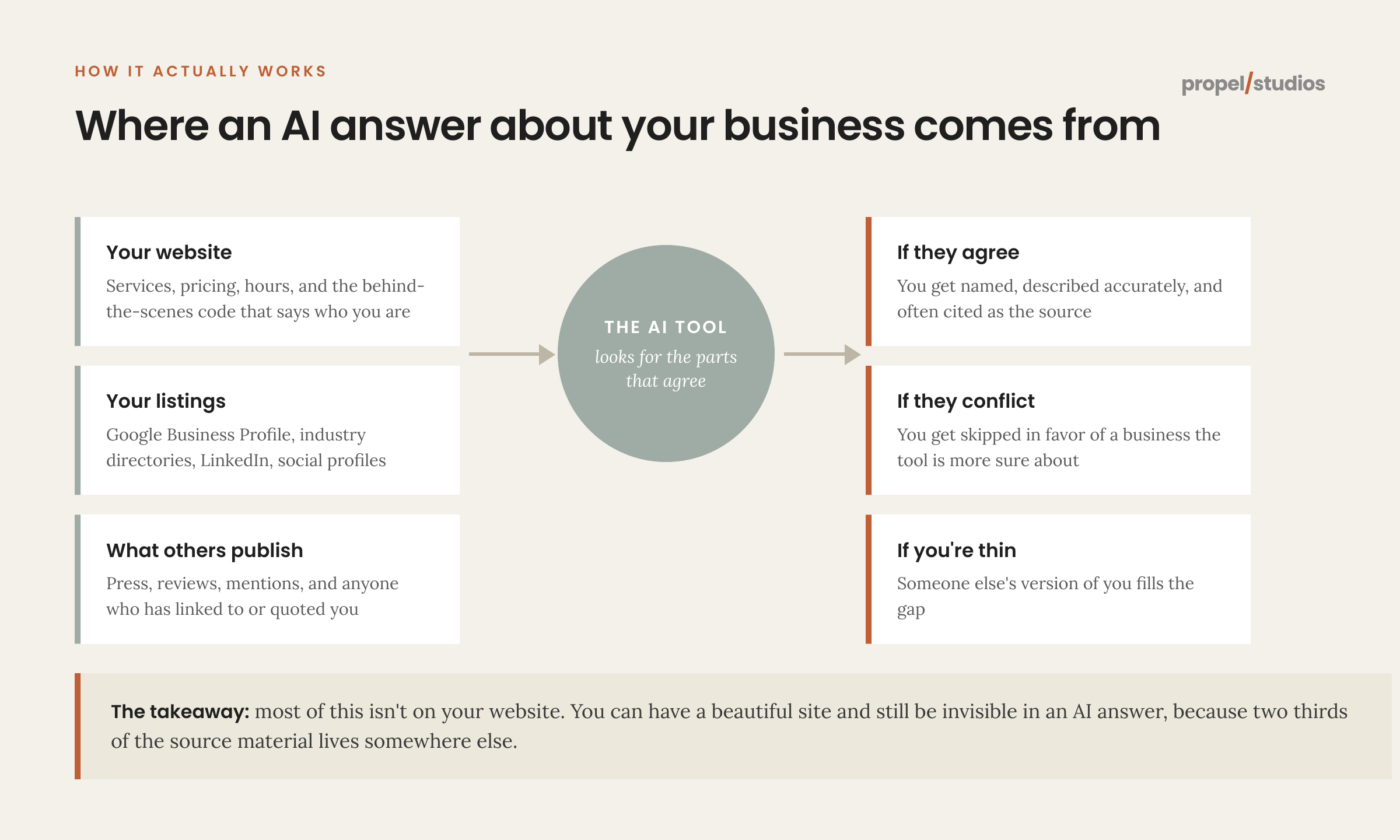
This is the part that surprises people. AI answers don't just read your site. They look for agreement across sources, and they weight what other people say about you over what you say about yourself.
So your Google Business Profile, your directory listings, your LinkedIn, and your site all need to tell the same story with the same details. A phone number written three different ways across four places is a small thing that does real damage, because it makes you harder to resolve as one consistent business.
And if nobody credible has written about you, quoted you, or linked to you in the last year, there's not much for those tools to agree on.
One thing that doesn't belong on the list: llms.txt
You've probably seen this one recommended. The idea is that you add a file called llms.txt to your site, and AI tools use it to understand you.
As of mid-2026, the evidence doesn't support it. The major AI crawlers, including GPTBot, ClaudeBot, and PerplexityBot, overwhelmingly skip the file and read your regular HTML instead. Google updated its documentation in June 2026 to say plainly that llms.txt has no effect on Search rankings or AI Overviews, positive or negative. Analyses of what actually predicts AI citations have found no correlation.
It doesn't hurt to have one. It just isn't the fix it's being sold as, and the hour it takes is better spent on the pages themselves.
The basics still count
None of this replaces the old list. A site that's slow, broken on a phone, or sending contact form submissions into a dead inbox will lose people no matter how well a machine understands it. Speed, mobile, working forms, consistent design, current testimonials, a clear next step on every page. Still the foundation.
The shift isn't that the old work stopped mattering. It's that a second layer got added on top, and most audits haven't caught up.
Start by writing down where you are
Whatever you fix, do this first: record where you stand today. How many visitors, where they came from, what they did once they arrived. Set up your analytics so AI traffic shows up as its own category, because by default a lot of it lands in "Direct" and disappears.
Six months from now you'll want to know whether any of this worked. You can't go back and collect that number after the fact.
We put the whole thing into a checklist you can work through in about an hour, on the site you already have.
Grab it here.